Winter Treasure from the Sea

FOOD FOR THOUGHT: The cold waters of Winter nurture mature oysters to rich, plump perfection. Today we will explore cooking oysters on the grill or the taste of your grill in your oven or broiler for those trapped inside in this cold weather.
WHAT EXACTLY ARE OYSTERS? Edible oysters are bivalve mollusks. They are filter feeders drawing in water for both plankton as food and oxygen, at a rate of 2.5 gallons per hour. Oysters are a product of their habitat, the purer the water the better the oyster. Other water-borne nutrients nourish the oyster and ultimately contribute to each oyster varietals’ unique flavor and texture, uniquely specific to their ocean homes.
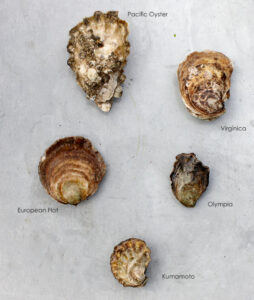
WHERE DO OUR OYSTERS COME FROM? The Atlantic coast is native to the Crassostrea Virginica commonly named after their source such as Blue Point, Wellfleets and such. The Pacific coast is native to Ostreola Conchaphila or Olympia Oyster and the Pacific Oyster Crassostrea Gigas also named for their origin. The Japanese Kumamoto is also a very hearty and popular coast grown on our Pacific coast as well. Oysters are commonly named after their ocean homes not by their Latin species names.
SELECTING YOUR OYSTERS: Ask your fishmonger for the freshest oysters they have. They should also be able to describe each oyster’s unique taste profile. Often they will let you try them before you commit to a couple of dozen.
Oysters should smell sweet, never fishy. They should be heavy still full of juices. They should never be open or gaping. Store under refrigeration but use quickly. Do not consume if the oysters are open.

ADVANTAGES: Oysters are nutritionally balanced with proteins and lipids. They are an excellent source of Vitamins A, B, C and D. A serving of oysters will contribute a recommended daily nutritional value of iron, copper, iodine, magnesium, calcium, zinc, manganese and phosphorus. Even with all these nutrients they are quite low in calories, about 10 per oyster.
CLEANING YOUR OYSTERS: First scrub the oyster under running cold water to remove any ocean grime. Wrap the oyster with a cut proof kitchen towel and wear a cut resistant glove to be safe. Secure the oyster to the counter, inserting the oyster knife blade at the hinge of the shell and pivoting the knife to force the shells apart. Slide the blade forward to cut through the abductor muscle from the top shell to release the top flat shell. If necessary, rinse the meat in the shell to remove any shell fragments. Store under refrigeration under damp paper toweling.
https://fultonfishmarket.com/blogs/articles/how-to-shuck-oysters?srsltid=AfmBOooW5cnmO4o2wh31hoMtRQJ9QwAg2qmK3u-R7hoNwu1CkumYhk1-
TRY YOUR TECHNIQUE: Try Grilled Oysters with garlic Chipotle Butter for a warming taste to battle this cold weather.


GRILLED OYSTERS TOPPED WITH GARLIC CHIPOTLE BUTTER
makes 4 appetizer servings
Prep Time about 20 minutes Cook time about 10 minutes
1 cup Coconut Amino Acids or substitute low sodium, gluten free soy sauce (C=4g)
1/2 cup honey (C=64g)
4 cloves of shaved garlic (C=4g)
1 pound unsalted premium sweet butter (A2 milk based better) cut into tablespoon size cubes (C=2g)
1 small can Chipotle Chiles in Adobo Sauce (C=4)
(substitute Chilpotle Chile Hot Sauce to your taste)
sea salt (C=0g)
freshly ground black pepper (C=.5g)
2 tablespoons fresh lime juice (C=3g)
24 medium oysters, cleaned of exterior grime, shucked or opened (C=12.3g)(P=24g)
Coarse Kosher Salt to cook and serve oysters on as necessary
Preheat your grill or broiler or oven set to 450 degrees F.
In a medium saucepan combine the amino acids/soy sauce, honey and garlic. Bring to a simmer over medium high heat, cooking until reduced to a thick sauce consistency about 15 minutes. Remove from the heat and transfer to a metal bowl. Place the metal bowl in the freezer to chill until cold.
In a food processor add the cold amino acid-garlic mixture. Add a couple of the canned chipotle peppers and 2 tablespoons of the adobo sauce. Puree until smooth. Add part of the cubed butter pureeing until smooth. Add the rest of the butter pureeing until smooth. Add salt and black pepper to taste. Add the lime juice with final puree to incorporate all the ingredients. Note: You will have extra butter so store under refrigeration for up to 30 days as you will want to cook them again!)
On a sheet pan pour the kosher salt to make a bed for the oysters to sit upright in.
First scrub the oyster under running cold water to remove any ocean grime. Insert the oyster knife blade at the hinge of the shell. Secure the oyster to the counter, pivoting the knife to force the shells apart. Slide the blade forward to cut through the abductor muscle from the top shell to release the top flat shell. If necessary, rinse the meat in the shell to remove any shell fragments. Cut the oyster free of the shell maintain the location of the meat in the shell. Transfer to the kosher salt bed upright. Repeat until all the oysters are opened.
Scoop a large tablespoon of the butter and form over the oyster to cover all.
To grill: Place the oysters upright on the grill. Cover the grill allowing to cook until the edges of the oyster begin to curl and the butter is bubbling. Transfer to a bed of salt mounded in the center of the serving plate. Serve immediately.
To Broil or Roast: Place the sheet pan with the oysters directly into the broiler or oven, cooking until the butter is hot and bubbling. Transfer to a bed of salt mounded in the center of the serving plate. Serve immediately.
COOKING NOTE I: (C=0g)(P=0g)(F=0g) indicates the total carbohydrates, protein and fiber in grams for the ingredient listed. In this dish there are 12 grams of carbohydrates, 6 grams of protein and 2 grams of fiber per serving.
© Jimmy Schmidt – Rattlesnake