The Secrets of Creamy Risotto

THE CREAMIEST RICE OF THEM ALL, RISOTTO
WHAT EXACTLY IS RISOTTO? Risotto is made from a specific type of rice that is high in starch, which when cooked by an unique technique develops into a creamy texture while still maintaining a certain firmness of the rice grain.
WHY IT TASTES SO GOOD: First of all risotto is generally made with a seasoned stock or broth that matches the garnishes of the dish,, such as today the flavor of ginger. The broth or stock is absorbed into the rice during cooking creating rich, full flavor while the garnishes are introduced later to finish cooking in conjunction with the rice.
WHAT MAKES THE RISOTTO CREAMY? The outer starch layers of these specific varieties of rice grains are released during cooking to mix with the stock, thus thickening the liquid into a sauce-like consistency. The balance between too much liquid like soupiness and the thickened creamy texture is controlled by the addition of liquids and cooking time, the perfect result is sheer “creaminess”. Butter and cheese may be added at the end of cooking to further enrich the taste and the texture but it is not necessary to create the natural creamy texture.
CHOOSE THE BEST GRAINS: Although the rice for risotto is more expensive than processed rice, it performs in a way that can not be duplicated by other rice varieties. Select “Riso Fino” or the best “Riso Superfino” Italian varieties for the best results in making a true risotto. Arborio is the best known but Vialone Nano Semifino and Carnaroli are both very superior.
PREPARING YOUR RISOTTO: Assemble all the ingredients for the making of your dish so that you may add them at exactly the correct moment for the best results. The risotto won’t wait during cooking for you to catch up on chopping or cutting any of the ingredients.
- Stocks or broth – Bring to simmer the light broths or stocks that will be used as the liquid in the recipe.
- Wine – is a common addition to a number of risotto, primarily to provide additional flavor and acid to balance. Select dry white wines to match your dish.
- Spices and herbs may be added in the beginning, the end or both to develop respectively the background, the highlight or combined flavor profiles.
- Season gently with salt and pepper as you go through the cooking so that the flavor may be carried in the rice kernel as well, not just the creamy part leaving the rice grain bland.
- Cheeses are added only at the final seconds, mixed in quickly always OFF the heat and immediately served. Finely grated parmesan and romano are the most common cheeses of choice.
TRICKS OF THE TRADE: The risotto takes time so carefully watch it during the approximate 20 minute cooking time. The rice may be partially cooked by the same technique as above, removing from the heat after about 3/4 of the stock has been introduced, transferred into a large shallow baking pan and cooled under refrigeration to halt the cooking process. This procedure converts the simple rice carbohydrate to a complex carbohydrate with lower calories and less effect to your glycemic index.
To complete the dish, combine the cold rice and most of the remaining hot stock, bringing to a simmer over high heat. Add any garnishes and the last liquid and finish cooking until creamy. The texture may be a little more dense and softer than cooking the rice straight through but may be more convenient for entertaining, and improve the nutritional outcome of all these carbs.
WHAT EXACTLY ARE SEA SCALLOPS? Sea scallops are the largest of the 400 or so member scallop family with a firm textured, sweet meat. They are marine bivalves with orb-shaped shells that when quickly
opened and closed cause the scallops to zigzag in flights through the water. They are free swimming and migrate during certain times of the year to different feeding grounds. The scallop meat consumed in the United States is the abductor muscle, which opens and closes the shell. This abductor muscle is larger in the scallop than any of its bivalve relatives the oyster, clam or mussel. The scallop shell is opened and the abductor is cut from the shell with the rest discarded into the ocean. In the rest of the world, especially Europe, the entire contents of the scallop is enjoyed especially the orange colored coral or roe of the scallop.
WHERE DO OUR SCALLOPS COME FROM? Sea scallops come from the north Atlantic coast from New Jersey to Labrador Canada, specifically concentrated off the coast of Maine. They are dredged from the sea bed as deep as 900 feet.
The best scallops are called diver or day boat scallops. Divers are collected by hand by divers and they are generally the largest in size. Day boat refers to boats that fish for scallops just for the day, rather than the
traditional method of dredging for up to 10 days before returning to harbor.
Scallops may be soaked in a phosphate dip which adds weight, turns them more white and mushy in color and lengthens shelf life. I find
that soaked scallops have lost their soul and the additional moisture prevents proper cooking.
SELECTING YOUR SCALLOPS: Select translucent not white scallops that are firm not mushy or shredding. They should smell sweet, never fishy or of iodine. The best are shipped in muslin bags. Store under refrigeration but use quickly.
SECOND TRICK OF THE TRADE: Serve the risotto immediately since the internal heat of the rice will continue the starch absorption of liquid, thus quickly becoming dry. Leave the risotto a little on the loose side while you wrap up other dishes to accompany the risotto and serve as the risotto thickens.
WHAT ARE WHITE TRUFFLES? White truffles are a rare underground Tuber Magnatum Pico variety, typically from Italy, although some common from USA Northwestern states. They grow symbiotically with the roots of hardwood trees. White truffles have a pungent, earthy, musky aroma with a “sexy” spice scent which is best experienced raw shaved thin with a “mandolin”.
TRY YOUR TECHNIQUE: For a taste of the sublime try the following Sea Scallops with White Truffles and Ginger for this holiday season!

Sea Scallops, Ginger & White Truffle Risotto
Makes 4 Servings of about 56 grams carbohydrates,
31 grams of protein and 4 grams of fiber each
Prep about 30 minutes – Cook time 30 minutes
For the stock and garnish:
1 tablespoon olive oil (C=0g)
1/2 cup shallots, diced (C=17g)(P=2.5g)
1 large peeled ginger root, slice paper thin, then cut into julienne to yield 1/4 cup, reserve trimmings and peel for stock (C=8g)(P=.5g)
3-1/2 cups of light vegetable stock or water
1 cup sugar(C=20g) attributed to the ginger
For the garnish oil:
1/4 cup white truffle oil
1/4 cup chives (C=2g)(P=2.5g)
For the risotto:
1 tablespoon olive oil
1 tablespoon minced shallots(C=4g)(P=.6g)
1 cup Italian rice, suitable for Risotto such as Arborio(C=160g)(P=20g)
1 cup dry white wine (C=8g)
sea salt
freshly ground black pepper
4 giant Sea Scallops (U-10) (C=6g)(P=48g)
1/4 cup finely grated parmesan cheese (C=4g)(P=40)
1 small white truffle, shaved with a truffle mandolin(F=8g)
1/4 cup picked cilantro leaves or substitute chives (scant)
To make the stock: In a large saucepan over medium heat the olive oil. Add the half cup of shallots and ginger trimming cooking until the shallots are translucent about 3 minutes. Add the stock or water, adjust heat to a simmer, cooking for 30 minutes while you prepare the other ingredients. Strain before adding to the risotto. Keep hot.
To make the crispy ginger garnish: In a small saucepan over high heat combine 1 cup sugar and 1 cup water. Bring to a simmer. Add the julienne of ginger cooking until tender but not falling apart about 5 yo 8 minutes. Transfer the ginger to a strainer and drain collecting the ginger syrup for you coffee or tea.
In a medium saucepan heat over medium high heat add oil to a depth of about 2 inches. Heat until 355 degrees f. Carefully add the ginger julienne, cooking until golden just a few minutes. Remove the ginger from the oil with a slotted spoon transferring to paper towel lined tray. Reserve for garnish.
To make the chive-truffle oil: In a small blender combine the white truffle oil and chives, blending until smooth. Add a little ginger stock and salt to taste. Reserve.
To make the risotto: In a larger wide saucepan over medium high heat, add 1 tablespoon of olive oil and minced shallots, cooking until translucent about 2 minutes. Turn the heat up to high and add the rice, cooking until the grain is hot to the touch. Add the white wine cooking until absorbed, about 2 to 3 minutes. Add about 1/5 of the warm stock, returning to a simmer. Adjust the seasoning with a little salt and pepper. Stir occasionally to insure even cooking. As the rice begins to thicken from the absorption of the stock add more stock in similar proportions. Continue this technique until the last addition of stock is remaining.and the rice is creamy. Remove from the heat. Add the cheese and adjust the seasoning.
While the risotto is cooking and about 2/3rds of the stock has been added, heat a medium non stick skillet over high heat. Season the scallops with salt and pepper. Add a couple of drops of oil to the skillet. Place the scallops seasoned side down into the hot pan searing the surface well, while allowing to cook about 3 minutes. Turn over the scallops cooking to your desired degree of done SS and additional 2 to 3 minutes.
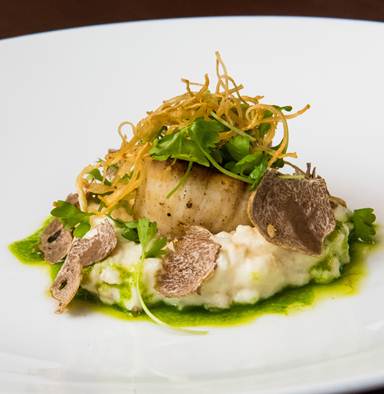
Spoon into the center of warm rimmed soup plates. Position the scallop atop the risotto. Garnish with the sprigs of cilantro, chive oil around, shaved white truffles and crispy ginger atop.
©Jimmy Schmidt
COOKING NOTE I: (C=0g)(P=0g)(F=0g)indicates the total carbohydrates, total protein & total fiber in grams for the ingredient listed.